Investing in the Energy Transition - inspiratia's industry insights
 Ashkenaz A.L.
Last week [2 October 2024], inspiratia flew down to Milan for 'Investing in the Energy Transition'. Our inaugural event in the Italian market attracted more than 300 attendees across investors, developers, lenders, and advisers who are playing a crucial role in the transition to a net-zero future. The panels offered insights into the constantly evolving equity and debt financing strategies in the renewables space. The major spotlight was on Italy, where investors eagerly await regulation and contracts for difference (CfD) auctions to propel the market forward.
inspiratia insights:
- Commercial lenders have already been positioning themselves while waiting for key regulations to come into effect
- BESS is where lenders' attention is focused as hydrogen is still not seen as bankable, and floating offshore is still perceived as being too expensive and risky
- Alternative lenders pointed out that while debt funds and commercial banks are still complementary on the macro level, debt funds are starting to replace banks on the micro level
- MACSE will help fill in the gaps in investor and developers' portfolios in the Italian BESS sector
- The biofuels sector's main challenge is securing sustainable feedstock, and Italy has solid regulations in place to ensure that
- Floating wind developers told the audience that the technology is where offshore was 20 years ago
Monica Colombera, Partner at Legance, gave the opening remarks, highlighting the attractiveness of the regulatory framework in Italy, which supports technologies that have not fully matured yet. She also spoke about the rapid growth of the BESS sector in Italy as investors eagerly await the upcoming MACSE auction.
She said: "In Europe, despite the pandemic, we are witnessing a gradual evolution of the sector. Today. The global energy transition has also stimulated investments in technology. Today, we see the development of projects that were not possible to imagine just a few years ago."
Investing: The energy transition
Emiliano Scrivo – Executive Director, CIBC
Nicola Di Agostino – Chief Specialist Project Finance, Bayern LB
Cecile Luciano – Associate Director, Nord/LB
The panel was moderated by Pierpaolo Mastromarini, Partner, Bird & Bird
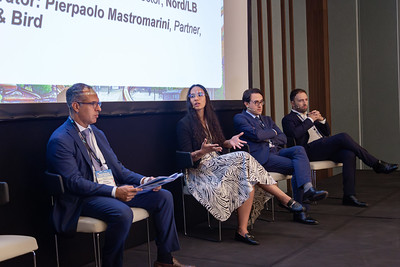
Right from the start of the session, it was clear that all eyes were on the regulation in the Italian market, in particular the FER-X and Mechanism for the Acquisition of Storage Capacity (MACSE) auctions. The panellists highlighted the value of securing long-term CfDs as one of the best offtake options for sponsors to secure debt financing. As a result, commercial lenders have begun positioning themselves while waiting for key regulations to come into effect.
However, the Italian market is not without its challenges. In particular, the challenges and delays in obtaining planning authorisation were seen as major setbacks, especially for large-scale projects. These utility-scale projects take far longer to secure planning permission than smaller projects.
This is a major challenge for sponsors as the bankers on the panel said that they were less keen on lending to small projects where the tickets were too small. In such situations, portfolio financing was seen as the preferred option.
The panellists observed that despite the progress made in deploying new renewables generation, Europe is still far behind its stated net-zero targets. In order to achieve these ambitions, there is a need for strong public policy support for newer technologies like green hydrogen.
Scrivo from CIBC said: "I think the number one reason why hydrogen and e-fuels projects are difficult at the moment is the lack of a bankable offtake. Without government support, developers have to rely on corporate offtakers, and those offtakers are not there as no one wants to take a risk on those prices."
The bankers noted that these early projects are often economical, and that state support is needed to progress these projects as the technologies and the market evolve and shift towards more private capital.
Financing streams: Beyond commercial banks
Daniele Tabacco – Head of Europe Origination, Green Credit Fund, CIP
Ahmed Zaki – Managing Director, I Squared Capital
Fabio Guglieri – Senior Client Relationship Manager, SACE
Enrico Lucciola – Project and Structured Finance, Cassa Depositi e Prestiti
The panel was moderated by Arturo Sferruzza, Partner, Norton Rose Fulbright
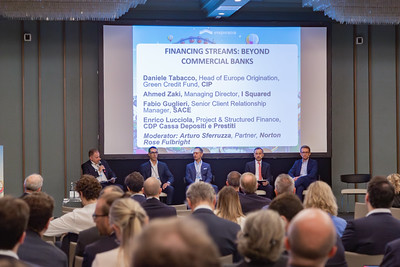
The focus on the event then shifted from commercial banks to institutional lenders, multilaterals and ECAs in the infrastructure debt space.
On a macro level, debt funds and commercial banks are still seen as complementary, as they operate on different risk profiles, with banks tending to go for "vanilla" financing structures and thoroughly derisked assets, one of the panellists said.
However, debt funds are starting to replace banks on the micro-level, some noticed. The fund managers on the panel pointed out that for sponsors, having a relationship with debt funds can be critical, as these funds can offer more flexibility and longer-term loans than traditional banks.
The panellists highlighted that the private credit space is growing very fast. CIP's Tabacco observed: "There has been a marked rise in terms of floods of capital towards debt funds, particularly into the high-yield, sub-investment-grade infrastructure debt space, and this interest is expected to continue."
On the demand side, sponsors and developers are looking for more sophisticated forms of financing that are able to address new commercial and development risks that have emerged.
Meanwhile, export credit agencies like SACE can be critical in financing the energy transition by providing loans to sponsors at more concessional terms compared to other lenders in the market. SACE highlighted its role in helping Italian sponsors by providing them access to the market and helping secure long-term financing.
Regardless of the provider, there will continue to be a huge need for financing to support the transition to net zero, with some estimates placing it at $120 billion between now and 2030.
The traditional project financing market is rapidly evolving, with holdco, mezzanine, mini-perm, construction and bridge loan structures gaining ground. Alternative lenders are seen as best placed to take advantage of this trend, particularly as they bring attention to their ability to provide bespoke solutions that are tailored to the sponsors' needs.
M&A Financing: Battery storage and repowering aging assets
Miguel Solana – Partner, Alter5
Diomidis Dorkofikis – Partner, Foresight
Marcos Szutan – Partner, Green Oasis Energy
The panel was moderated by Giovanni Paolo Di Giovanni, Senior Director, JLL.
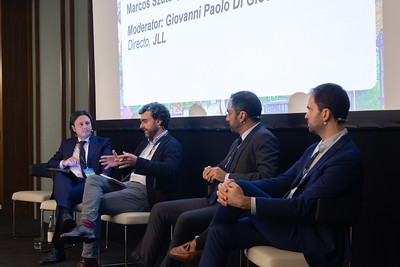
As penetration of renewable generation increases, particularly in countries like Spain and Italy, battery and energy storage systems (BESS) is becoming crucial for managing the intermittency of power. As a result, sponsors and investors require innovative equity and debt structures to fund their development pipeline.
The panel highlighted the benefits of investing in co-locating BESS projects with wind and solar generation, despite the risks of the two technologies cannibalising each other's revenues. Deploying BESS could play a role in bringing curtailment costs down for the grid, which also makes projects more resilient to market changes. Just like in the US, it has increasingly become imperative in Europe for BESS to be a part of the development of any renewable generation assets.
Having co-located battery storage projects is also an attractive way to finance the asset class, as it provides lenders with a mix of contracted revenues from the generation assets, while keeping the BESS itself merchant.
Green Oasis Energy's Szutan quipped: "I think solar as an asset class has been a victim of its own success".
Szutan went on to explain how the high penetration of solar in several markets has led to a drop in the capture price, which is the volume-weighted average spot market price. Solar developers will need to adapt by structuring projects in a way that accounts for this shifting environment. Sponsors will need to secure a long-term PPA or tariff in order to create a bankable business case, he concluded.
Spain was mentioned as a market with a lot of exciting potential. However, the regulations surrounding BESS in the market were considered disappointing. This has led to uncertainty in the market, as investors are keeping a close eye on Spain, yet no one is willing to take a big bet on the market.
For investors looking to enter the BESS space right now, the revenue risks supersede the technology risk. Moving forward, sponsors will need to look at the dynamic impact of increasing BESS deployment 20 years from now, as having more energy storage on the system could decrease volatility on the grid, which could lead to lower prices.
Investing: Battery Storage – The crux of the energy transition
Emanuele Taibi – Country Manager - Italy, Field
Alessia Saibene – Investment Director, Sosteneo
Lucie Kanius-Dujardin – Executive VP of Global Markets, NHOA Energy
James Taggart – Vice President, Cero Generation
Alex O'Cinneide – CEO, Gore Street Capital
The panel was moderated by Lorenzo Parola, Managing Partner, Parola Associati
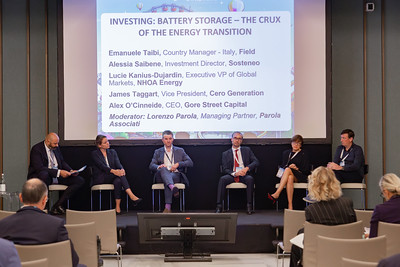
While battery storage has played a significant role in all previous panels, this one focused its entire attention on the technology.
BESS will play a key role in accelerating the energy transition in Italy. The panellists noted that despite the high penetration of renewables in the south of the country, coal-fired power plants are still active and used to perform grid services. BESS assets have an opportunity to replace those fossil fuel plants.
While the BESS market has been growing steadily in Italy, the developers on the panel highlighted challenges such as unclear market regulations and slow project development timelines.
Taggart from Cero Generation explained: "We compare that to countries like the UK and Poland. Both of those have very long development timelines but offer slightly more visibility. This allows us to make plans, and we start putting teams in place."
Companies are optimistic about Italy's potential despite the challenges, and strategic approaches are needed to align market structures and overcome regulatory barriers.
Investors on the panel showcased a range of different opinions and strategies for revenue stacks. Some are attracted to MACSE for the stable cash flows that it promises and pointed out that the price floor would provide a level of certainty, attracting more lenders to the market.
However, others were less enthused about the tender, seeing value in the volatility offered by the merchant market in northern Italy. Gore Street's O'Cinneide argued that on a fundamental level, BESS is a merchant asset.
Meanwhile, some developers liked the certainty of revenues that the auction would provide but would still keep some of its capacity merchant in order to retain flexibility and perform different services for the grid as the market evolves and harness new opportunities that arise.
Destigmatising Risk: Developers and offtakers build their case
Peer Piske – Managing Director, Alantra Solar
Alice Cajani – Global Director Energy Management, Enfinity Global
Jesús de Pablo – Head of Structured Finance and M&A Europe, Fotowatio Renewable Ventures (FRV)
Javier Flamarique – Director Project Finance, Econergy
The panel was moderated by Cristina Martorana, Partner, Legance
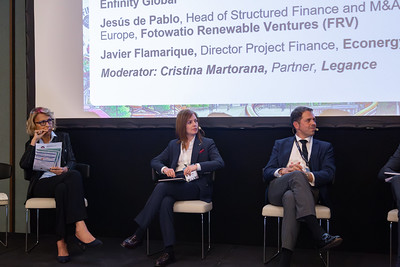
Securing a credible offtake strategy is crucial when entering a new market. The developers on the panel highlighted the importance of balancing the needs all the interested parties when preparing to secure offtake. Cajani from Enfinity viewed a PPA not as a single transaction but rather as a "long-term partnership that evolves over time".
The panellists discussed the right time for developers to sign PPAs. While there is no single answer, sponsors need to take into account the impact of the current energy prices in order to leverage the PPA more effectively.
Flamarique from Econergy observed that the best time to sign a PPA is when the project reaches a ready-to-build stage, as the asset becomes significantly derisked for the offtaker, and the long-term offtake agreement allows developers the opportunity to secure financing for lenders.
The conversation shifted back to the role of alternative lenders, as discussed, as some developers found that private debt providers are often willing to fill gaps in the market left by commercial banks.
Biofuels: The underrated renewable energy
Monica Foschi – Partner, MZF & Partners
Adriano Cordisco – CEO & Co-Founder ReFuel Solutions
Carlotta Trucillo – Deputy Director General, Assitol
The panel was moderated by Ashkenaz AL, Reporter, inspiratia

The penultimate panel of the day explored the crucial role of biofuels in the ongoing transition to net zero, as the technology could facilitate the decarbonisation of sectors where renewable electricity will not be enough.
The panellists began by debating a provocative statement – are biofuels the "silver bullet" to the energy transition that hydrogen was touted to be? Cordisco from ReFuel Solutions noted that while biofuels are currently one of the most effective tools in the energy transition, each technology has its place.
He highlighted the technology's practicality, compatibility with existing infrastructure, immediate CO2 reduction potential, and economic viability, making them a key component of the energy transition, offering investors an attractive ROI and lower CapEx requirements compared to other green technologies.
However, Foschi from MZF was even more enthusiastic, arguing that biofuel viability and practicality in today's gas infrastructure made it a powerful "silver bullet".
One of the biggest challenges for the biofuels sector lies in securing a sustainable feedstock. Securing guarantees of origin for feedstocks is essential for sponsors in order to ensure that projects retain their ESG credentials. Regulation can play a major role in ensuring the sustainability of feedstock. Italy has strong regulations in place, while EU-wide regulations can still be improved.
The panel also discussed the bankability of biofuels projects. While traditional renewables assets need to focus mainly on securing an offtake agreement. The challenge biofuels developers face is securing both a long-term offtake, and a supply agreement for its feedstock. Many sponsors in Italy are looking forward to the upcoming FER-X schemes, as long-term CfDs could help create a bankable business case.
Floating offshore wind: Friend or foe?
Paolo Grossi – Chief Commercial Officer, Galileo
Michele Schiavone – Project CEO, Copenhagen Offshore Partners
Stefan Vatchev – Executive Director, Project Finance & Infrastructure, CIBC
The panel was moderated by Viola Caon, Head of Content, inspiratia

Floating offshore wind is quickly becoming a hot topic in Italy, with many developers entering the market. Government incentive schemes are in place to accelerate early projects, with some floating offshore wind farms already progressing towards final investment decisions.
Floating wind developers told the audience that the technology is where offshore was 20 years ago. Doubts remain on whether floating offshore technology costs will decrease as quickly as developers initially hoped. As with new technologies, the asset class is expected to be heavily reliant on public sector support to reach commercialisation for early projects.
For the Italian market, floating offshore wind is the viable option, as the engineering and technical requirements of building offshore wind turbines off the coast of Italy, combined with the availability of favourable wind conditions, make floating turbines much more viable than fixed foundations.
Lenders stress the importance of sponsors having a clear project execution plan and urged them to begin conversations with banks early on, in order to create a bankable business case for their portfolio.