inspiratia’s Investing in the Energy Transition 2026: insights
 Evelina Skorikova
 Lorenza DellAquila

Italy’s energy market is still drawing capital, but it is asking more of those who want a piece of it. That was the thread running through inspiratia’s Investing in the Energy Transition summit, held at the Westin Palace in Milan on 1–2 October, where lenders, investors, developers, advisers and analysts examined how Italy’s energy transition is being financed and where the capital is likely to go next.
On day one, panellists discussed what it takes to get a project financed today: who is willing to lend, on what terms, and against which risks. Storage systems kept resurfacing, as did grid connection, permitting and the question of how much merchant exposure anyone is prepared to carry.
Pierpaolo Mastromarini, partner at Bird & Bird, opened the first day with welcome remarks before handing over to Luigi Michi, senior adviser at Key to Energy, for the keynote.
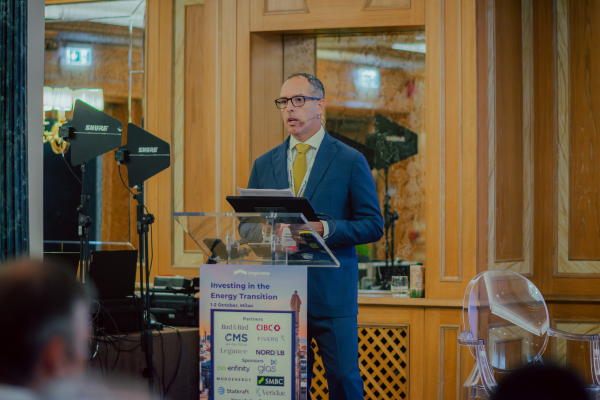
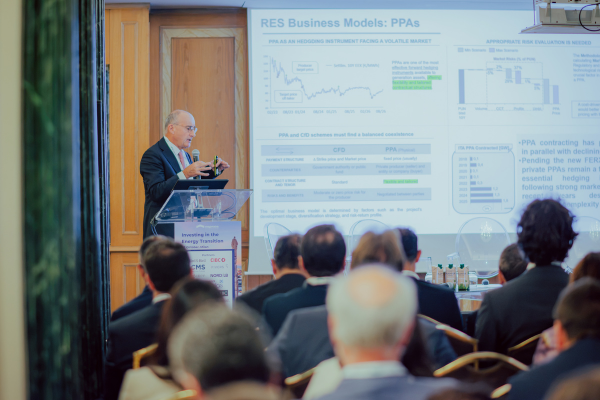
Michi touched upon standalone projects under MACSE and noted that the strongest approach combines schemes such as tolling and capacity, linked to each investor’s risk appetite.
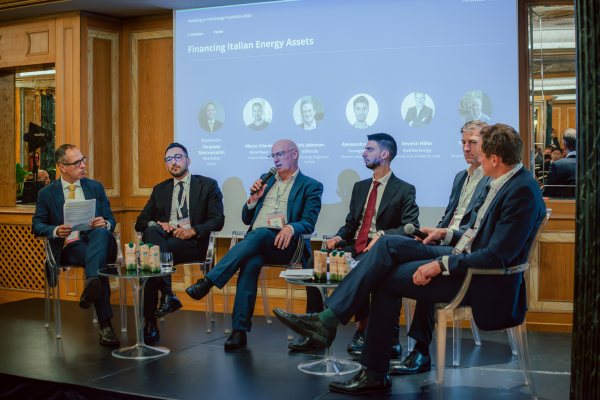
The first session of the day, Financing Italian Energy Assets, centred on platform financing, hybridisation with BESS, and what banks expect from sponsors and optimisers.
Speakers included:
- Marco Vilardo - Mirai Power | Finance Director
- Niels Jakeman - Nord/LB | Head of Energy Origination Europe
- Alessandro Campo - Foresight Group | Director, Asset Management
- Severin Hiller - Qualitas Energy | Partner and Co-Head of Credit
- Peter Allcock - SMBC | Director, Sector Lead - Energy Transition
The panel was moderated by Pierpaolo Mastromarini, Partner at Bird & Bird
Key takeaways:
- Italy is competitive but selective, and BESS co-location with a sponsor backing the grid connection mitigates most risks.
- Banks focus on platform finance with BESS alongside, sometimes via bridge financing, and then on mezzanine for projects not yet fully ready.
- Capital is still there, but fundraising is challenging, as investors move to platform strategies and banks become hyper-focused on risk.
- Banks like platforms for large underwriting, but platforms must be homogeneous in grid access, permitting stage and asset type.
- Hybridisation is crucial because BESS hedges risk and adds optionality in assets, capital and people.
- Banks will scrutinise optimisation strategies, so weak optimisers will be shut out.
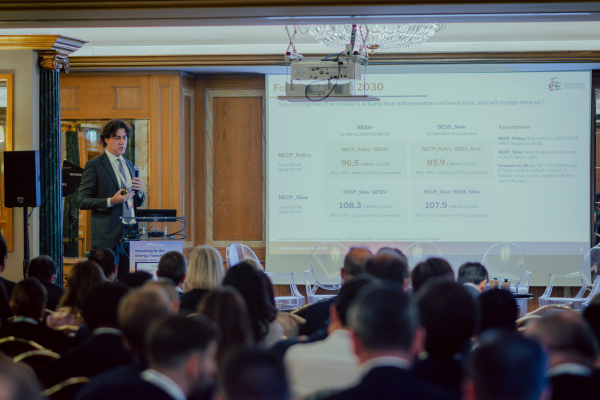
The presentation of SPARK Model by Prof. Federico Pontoni, Program Director at Fondazione Eni Enrico Mattei, took place with an overview of National Single Electricity Price Scenarios to 2030.
The second panel explored MACSE & Beyond: Financing Storage and Long-Duration Capacity in Italy.
Speakers included:
- Pedro Capote Martin - NORD/LB | Senior Director
- Paola Agrati - ContourGlobal | CEO Italy
- Alessandro Fossi - DNV | Senior Consultant Energy Systems
- Timothée Lauvergne - Modo Energy | Market Analyst, France & Italy
- Tiziano Caizzi - BW ESS | Investment Manager
The panel was moderated by Cristina Martorana, Partner at Legance.
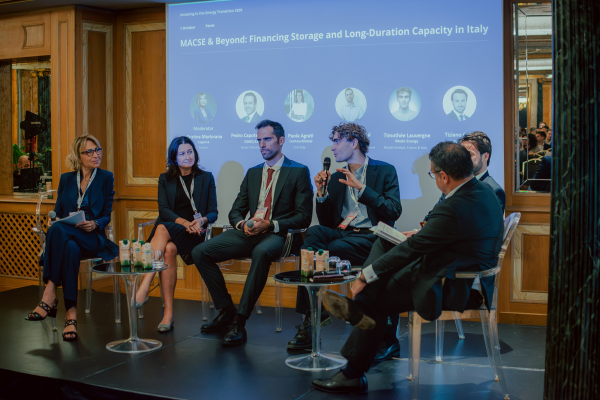
Key takeaways:
- The first auction was oversubscribed, and panellists expect future rounds to be too.
- MACSE is only part of the answer to Italy’s storage needs, and many developers will need other offtake solutions beyond it.
- Panellists called for a further MACSE-style auction for hydro and long-duration storage.
- Investors are taking a conservative approach initially, with around 20% of BESS revenue assumed in early models.
- The Italian government lacks a clear strategy for storage, and the future shape of the capacity market remains uncertain.
The third panel was Powering Italy’s Data Centres: Grid Access, Contracting and Capital Requirements.
Speakers included:
- Mickaël Abtan - Telis Energy | Director
- Danilo Serioli - Echelon Data Centres | Development Delivery Director
- Virginia Canazza - Key to Energy | Partner
- Andrea Monferini - DNV | Senior Principal Consultant
- Alessandro Bracaletti - CDP | Head of Project Guarantees
The panel was moderated by Monica Colombera, Senior Partner at Legance.
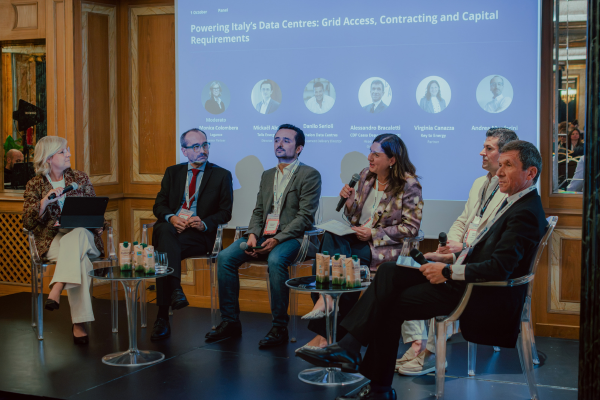
Key takeaways:
- Panellists expect around 1.6GW of data centre projects, currently at various stages of development, to come online in Italy by 2030.
- Brownfield sites in northern Italy offer development opportunities.
- Permitting is more difficult in Italy and Spain than in other markets, although Italy’s single authorisation procedure (autorizzazione unica) provides a consolidated route.
- Edge data centres could address latency constraints as connectivity shifts towards proximity to data.
- Access to clean power also supports local acceptance, which panellists ranked as the second most important factor after power.
The fourth session was a fireside chat between Matteo Ciminelli, Partner at CMS, who was moderating, and Tiziano Caizzi, Investment Manager at BW ESS, discussing Energy Storage at Scale: Growth, Partnerships and Execution. The panel covered the expansion of BW ESS, how it treats partners and suppliers, and its view of the Italian market.
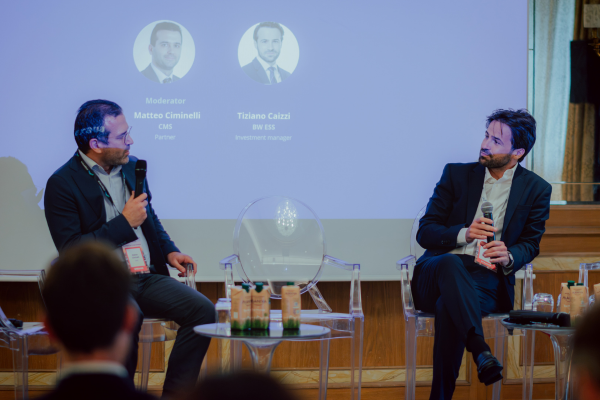
Key takeaways:
- BW ESS has new business in France and Portugal and sees its suppliers as partners.
- Authorisation is the main concern in Italy, although project volumes are good.
- Most projects are in the south, but there is flexibility in the north, where MACSE does not apply.
- Uncertainty makes the market difficult, but BW ESS draws on its experience, and entering fast matters.
Fifth panel, PPAs and Offtake Structures in Italy: Managing Bankability in a Fragmented Grid, discussed how PPAs and other offtake structures can be made bankable in a congested and fragmented grid.
Speakers included:
- Stefano Cavriani - EGO Energy | Founder & Director
- Simon Kornek - Statkraft | Vice President South European Origination
- Stefan Vatchev - CIBC | Head of Renewables, Energy Transition & Natural Resources
- Francesco Dolzani - Galileo | Managing Director for Italy
- Arthur Baltay - Modo Energy | Market Analyst
The conversation was moderated by Silvia Concettini, Project Leader at Aurora Energy Research.
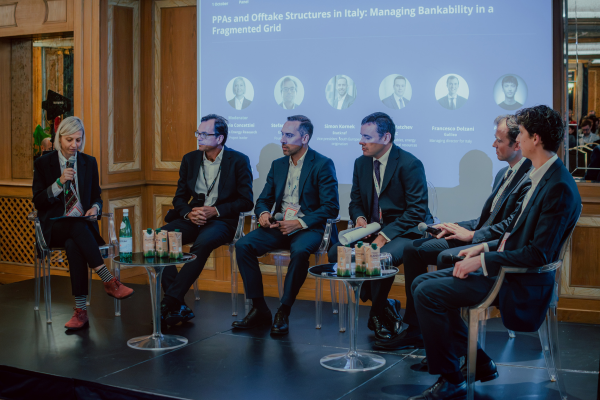
Key takeaways:
- The market is moving from pay-as-produced solar towards demand-matched structures.
- Solar “is not dead”: Italy is the biggest solar PPA market, despite a regulatory risk premium and zero-priced hours.
- Baseload is becoming a new standard, while tolling demand is strong and PPA demand reduced: FER-X’s December results will show what works better.
- BESS helps only as part of an integrated solution, and models miss tail risk.
- Optimal battery dispatch is key, and solar PPAs remain a useful way to spread risk.
- An asset owner can take the asset risk, and the market can take the market risk accordingly.
Panel six, Capital Allocation in Southern European Renewables: Italy, Iberia and the Eastern Med, compared growth and risk across Southern European markets and what drives capital allocation in each.
Speakers included:
- Raul Santos - Green Giraffe | Head of Southern Europe
- Sergio Leali - Green | CEO and Founder
- Gianandrea Massola - Augusta & Co | Associate Director
- Carlos Merida - Enfinity Global | Director of Project Finance Europe
- Miguel del Río Florentino - Nexwell Power | Head of Structured Finance
The panel was moderated by Daniel Garcia, Country Head, Spain, at GLAS.
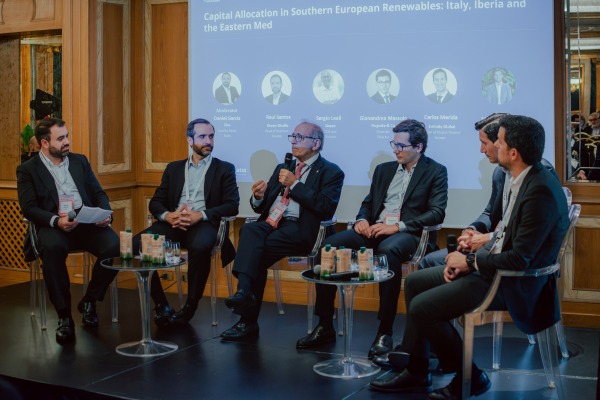
Key takeaways:
- Growth is demand-driven rather than generation-driven.
- Italy’s bottleneck is permitting, while Spain is faster but needs technology mixes to avoid cannibalisation.
- Developing an asset is not the same as commercialising it.
- More contracted revenue allows more optimisation but captures less value.
- Policy should take a system approach, with municipalities aligned and the grid funded.
The final panel of the day focused on Biomethane and Advanced Biofuels in Italy: The Role of Institutional Capital.
Speakers included:
- Claudia Pala - ING | Director
- Raffaele Romano - Ludoil Energy | CFO
- Nicolò Balice - Suma Capital | Investment Director
- Valentina Mercati - Five-E Responsible Investment | CEO, Italy
- Kalyani Panse - CIBC | Executive Director, Energy Transition & Natural Resources
The session was moderated by Maria Teresa Solaro, Partner at Fivers
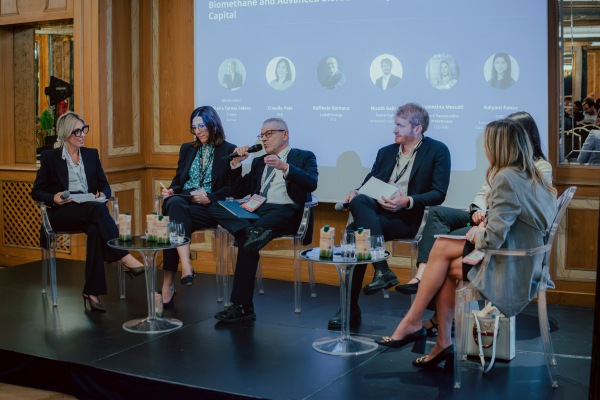
Key takeaways:
- The sector can stand alone today but probably not in future.
- Risk matters more than permitting, and projects need a minimum IRR beyond incentives.
- Feedstock is the core risk, as revenues depend on it; however, local sourcing, strong contracts and backup suppliers manage that risk.
- As long as the feedstock is eligible, project revenues are more stable.
- Availability analysis is fundamental, and developers and investors must work together and watch the next auctions for barriers such as cash deposits.