German BESS market profile: Scaling up for the next growth phase
 Stanley Lam
Germany is the largest battery energy storage system (BESS) market in continental Europe. Ambitious decarbonisation goals and the phase-out of nuclear power have driven rapid growth in renewable energy capacity, increasing the need for flexible assets capable of balancing an increasingly volatile power system.
As investment activity continues to accelerate, what sets the German market apart from its European peers? Who are the leading developers and investors? And what challenges could affect the sector's growth trajectory over the coming years?
Snapshot of the market
As highlighted in inspiratia's recent analysis in July 2026, Germany experienced strong growth in BESS deal activity between 2020 and 2025. According to inspiratia’s Deal Database, the number of recorded deal activities increased from 4 in 2020 to 33 in 2025, representing a compound annual growth rate (CAGR) of 52.5%. More than half of these activities progressed to financial close, underscoring continued investor confidence in the market.
Momentum has remained strong into 2026. In Q1 2026, inspiratia had recorded 16 BESS projects reaching financial close, indicating another robust year for the German BESS sector.
Germany's BESS market remains relatively concentrated among a handful of experienced developers and advisers as per inspiratia’s data. Kyon Energy, which was acquired by TotalEnergies in 2024, is the leading developer of BESS projects in Germany, followed by Terralayr and RWE. In the legal advisory segment, CMS, Osborne Clarke, DLA Piper, and Watson Farley & Williams have been among the most active advisers on German BESS transactions. On the financial advisory side, Capcora and JLL have established themselves as key players in the market.
Growing from small to big
Germany's BESS market has historically been dominated by many smaller projects, whereas the UK developed larger standalone batteries. Since 2024, Germany's BESS market has increasingly shifted towards utility-scale projects exceeding 100MW, marking a transition from distributed portfolios to large-scale assets capable of attracting project finance.
Germany's BESS project pipeline by status
Source: JRC, processed by inspiratia
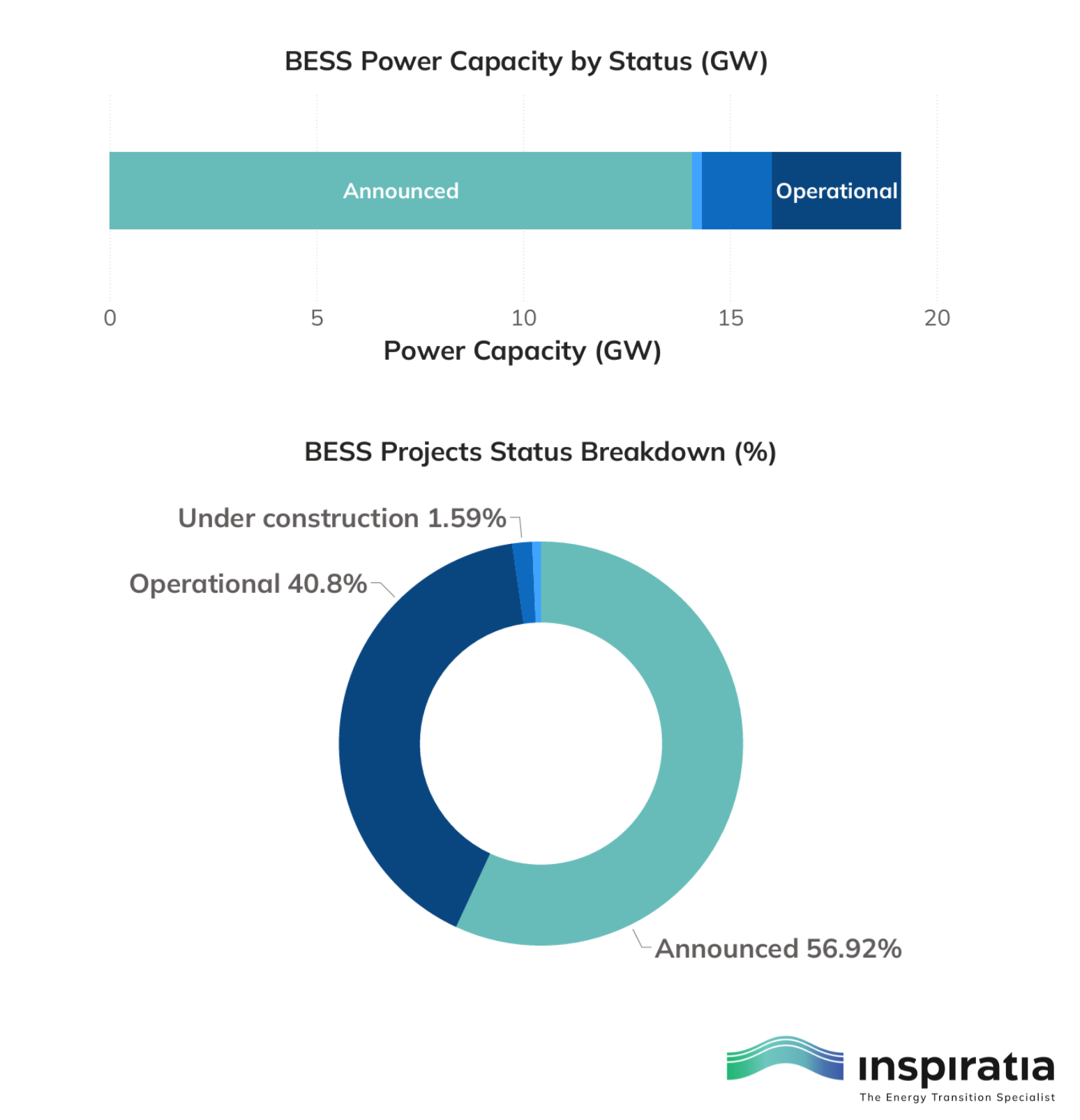
As of July 2026, Germany had 14.08GW of announced BESS capacity in the pipeline, alongside 1.7GW under construction and 3.12GW already operational. Recently, Kyon Energy and Allianz Global Investors secured a €440 million project finance debt package for a 789MW battery energy storage portfolio in Germany. The portfolio's revenue stack comprises ancillary services, including Frequency Containment Reserve (FCR) and automatic Frequency Restoration Reserve (aFRR), as well as revenues from grid congestion relief agreements.
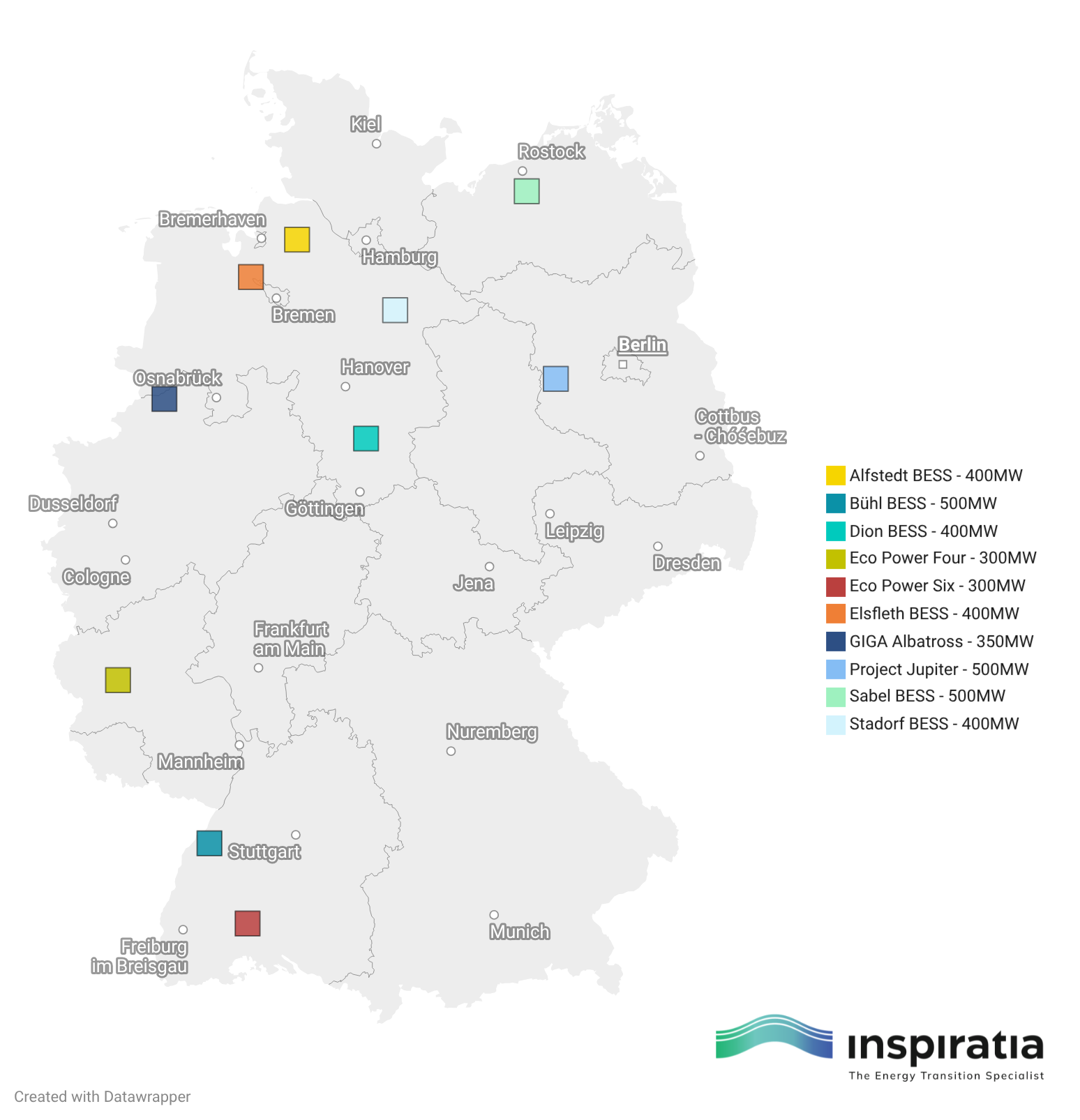
The market continues to expand rapidly, with a growing number of large-scale projects equal to or exceeding 300MW in capacity announced across the country. This wave of development highlights Germany's ambition to scale grid-scale storage and positions the market to narrow the gap with the UK.
List of announced BESS projects =300MW in Germany, as of July 2026
Project | Capacity | Location | Main Developer |
Alfstedt BESS | 400MW / 1,600MWh | Alfstedt, Lower Saxony | |
Bühl BESS | 500MW | Bühl, Baden-Württemberg | |
Dion BESS | 400MW / 1,600MWh | Lamspringe, Lower Saxony | Eku Energy (acquired from NION) |
Eco Power Four | 300MW / 600MWh | Wengerohr, Wittlich, Rhineland-Palatinate | |
Eco Power Six | 300MW / 716MWh | Weigheim, Trossingen, Baden-Württemberg | ECO STOR |
Elsfleth BESS | 400MW | Elsfleth-Vorwerkshof, Lower Saxony | Elements Green |
GIGA Albatross | 350MW / 1,400MWh | Near Neuenkirchen, Lower Saxony | |
Project Jupiter | 500MW / 2,000MWh | Brandenburg | |
Sabel BESS | 500MW | Rostock district, Mecklenburg-Vorpommern | |
Stadorf BESS | 400MW / 1,600MWh | Stadorf, Lower Saxony | Elements Green |
Source: JRC and inspiratia Deal Database
Note: Kyon Energy and Terralayr are not included, as they mainly develop portfolios of mid-sized BESS projects (100-150MW). RWE is also excluded because it typically funds projects with equity and moves them into construction shortly after announcement, leaving a relatively small announced-stage pipeline.
Germany's pipeline of announced large-scale BESS projects
Source: JRC and inspiratia Deal Database
Note: Projects displayed on the map are BESS projects =300MW in announced stage.
Fundamentals supporting growth
To further investigate the reasons behind the growth of Germany’s BESS market, inspiratia spoke with Alexander Enrique Kuhn, Managing Partner at Capcora, for details.
"Germany’s BESS market is strong primarily because of its market fundamentals, while the regulatory framework continues to evolve. Falling battery costs, increasing renewable penetration, price volatility and more frequent negative power prices are driving demand for storage and flexibility," Kuhn explains.
According to IRENA, global battery storage costs fell by 93% from $2,571 (£1,933 €2,256) per kWh in 2010 to $192 per kWh in 2024, and dropped another 30% in 2025 to roughly $140 per kWh for utility-scale systems.
"Some projects are seeking to reach FID before the AgNes reform, as developers assess the potential impact of the new framework on project economics," Kuhn adds.
Market players have put increasing concern on AgNes (Allgemeine Netzentgeltsystematik Strom) reform, which will overhaul the country's electricity network tariff system from 2029. The reform aims to redistribute grid costs more evenly across system users while introducing stronger incentives for grid-friendly behaviour. AgNes is particularly significant for the BESS sector as it will determine future network charging arrangements for storage assets and could materially affect project economics.
"Compared with the UK, Germany offers a more merchant-oriented market framework, providing storage operators with access to multiple revenue streams. At the same time, the market is still maturing, particularly around bankability for co-location projects and the introduction of hybrid PPAs," Kuhn concludes.
Capcora's recent white paper with Suena Energy argues that the bankability of German BESS projects increasingly depends on revenue certainty, particularly through tolling agreements. As project sizes grow, financing structures are shifting from predominantly equity-funded models towards greater use of debt, prompting lenders to place increased emphasis on revenue visibility and risk allocation.
What do the lenders say?
To get the lenders' perspective, inspiratia spoke with Florian Hock, Senior Director at NORD/LB, for details.
"As the market matures, revenue quality becomes increasingly important. The projects that attract financing are those that combine predictable cash flows with strong sponsors, secured grid access and robust contractual structures," Hock explains.
NORD/LB has recently closed a landmark financing with ECO STOR, the 300MW Foerderstedt BESS underpinned by a five-year flexibility tolling agreement with Next Kraftwerke.
"The successful financing of Förderstedt demonstrates that large-scale battery storage has become an investable infrastructure asset in Germany. It shows that well-structured projects can attract substantial financing support from both lenders and investors," Hock adds.
Another lender active in the German market told inspiratia that BESS investors were willing to accept merchant exposure given the country's favourable power price volatility. However, banks have generally been reluctant to rely on uncontracted revenues, with only a limited number becoming comfortable with fully merchant BESS structures. As project capacities continue to increase and lenders become more selective, developers may need to enhance revenue certainty through PPAs or other risk-mitigation incentives to secure financing.
At the same time, grid access is emerging as an upcoming challenge in Germany. As the BESS pipeline expands, competition for grid connections is increasing, leading to growing congestion and connection bottlenecks.
"The key challenge for the next phase of growth is likely to be less about capital availability, especially against the backdrop of good offtake contracts, but more about maintaining regulatory clarity and ensuring commercially viable grid access for projects coming to market," Hock summarises.
The next phase of growth
With high renewable energy penetration, ambitious decarbonisation targets and favourable market fundamentals, Germany is expected to maintain its position as the leading BESS market in continental Europe.
As projects continue to scale up, financing structures are also likely to evolve, with developers seeking to increase leverage through stronger revenue visibility and contracted income streams. While each market has its own characteristics, Germany's experience could serve as a valuable reference for emerging storage markets across Europe, where BESS deployment is accelerating at full speed.
Join us on 29 October 2026 at inspiratia's Energy Storage Summit Europe in Munich