Europe’s BESS race: Which markets will lead the next phase?
 Stanley Lam
EU
Battery StorageData InsightFinancial ClosePolicy & RegulationBattery energy storage systems (BESS) have become a key test of Europe’s energy-transition investment case. Rising renewable penetration, sharper price volatility and revenue stacking are supporting deployment, but opportunities differ sharply by market.
Which markets are leading in 2026, and where is growth likely to accelerate next?
Market momentum in transactions
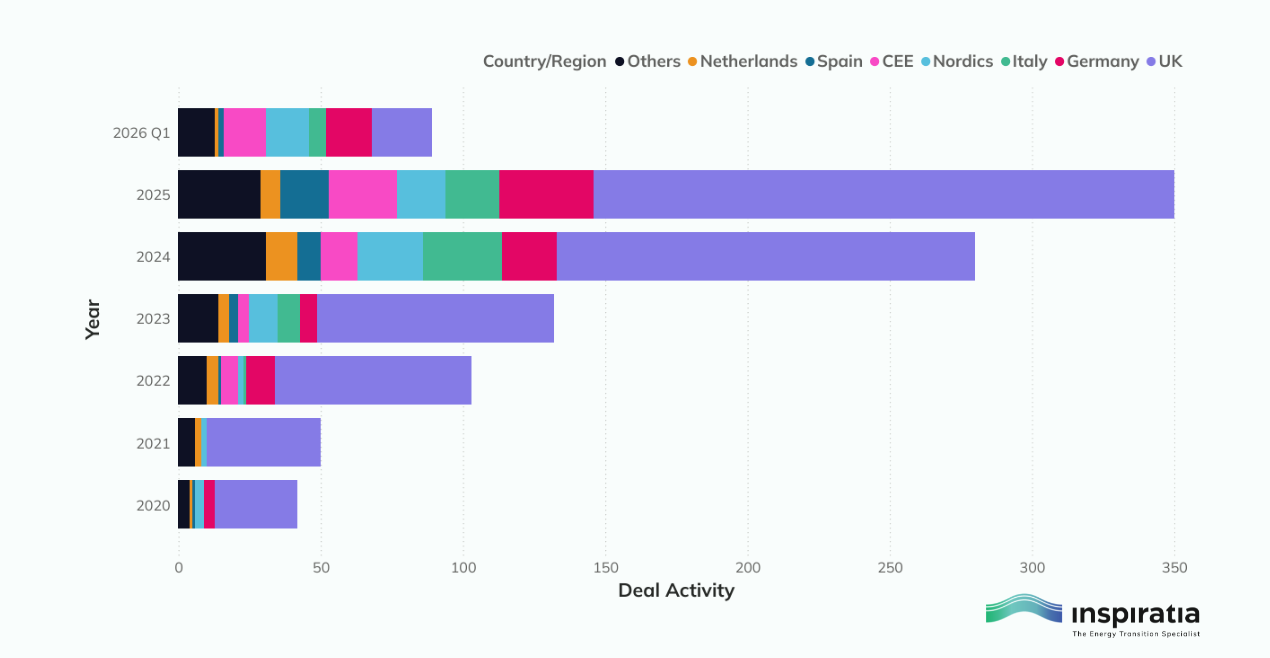
The UK has dominated European BESS deal activity since 2020, with Germany and Italy ranking second and third, respectively.
Annual deal activity for BESS projects in Europe, 2020-2026 Q1
Source: inspiratia, Deal Database
Note: Nordics data aggregate Denmark, Finland, Norway and Sweden; Central and Eastern Europe (CEE) data aggregate Poland, Bulgaria and Romania; Deal Activity includes projects in all stages
BESS deal activity in Europe has grown more than eightfold since 2020, rising from 42 transactions to 350 in 2025. The UK remains the dominant market, accounting for 57% of all recorded deals, with annual activity increasing from 29 transactions in 2020 to 204 in 2025. Germany and Italy follow as the next most active markets, while the Nordics and Central and Eastern Europe have gained momentum since 2022. With a total of 89 projects in all stages recorded in Q1 2026, Europe’s BESS market shows little sign of slowing.
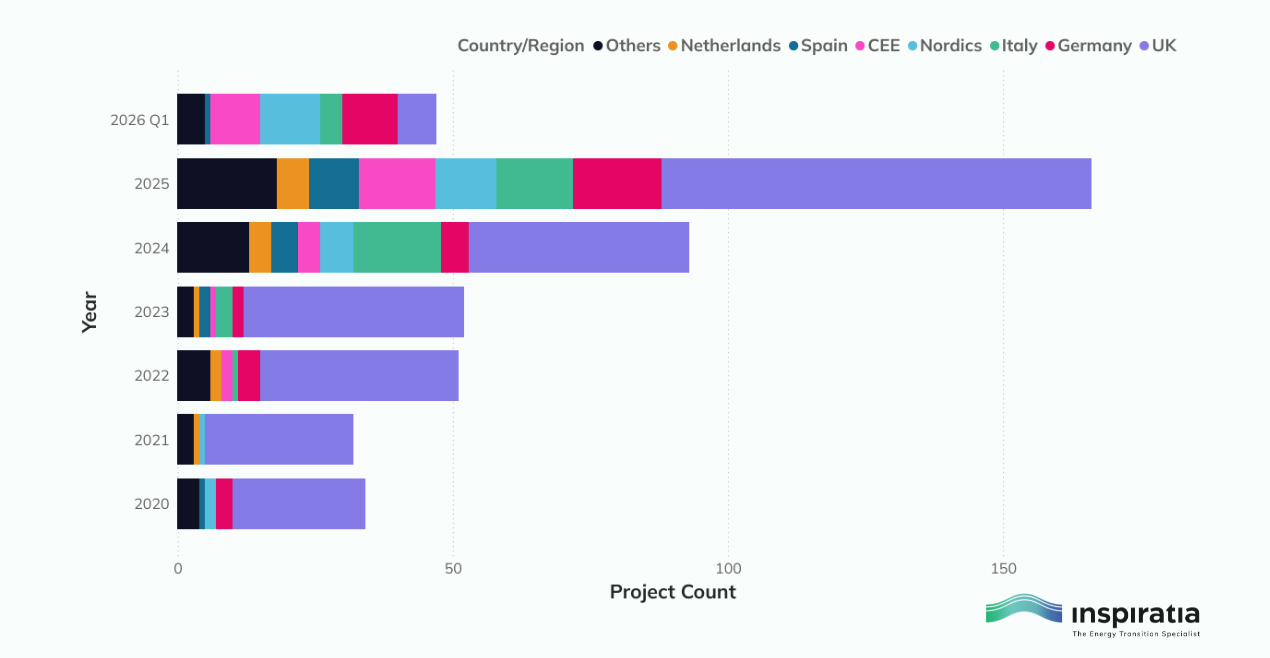
BESS projects to reach financial close in Europe, 2020 - Q1 2026
Source: inspiratia, Deal Database
Note: Nordics data aggregate Denmark, Finland, Norway and Sweden; Central and Eastern Europe (CEE) data aggregate Poland, Bulgaria and Romania
In terms of projects that reached financial close, the deal count rose across the region from 34 in 2020 to 166 in 2025. The UK remains the clear leader, accounting for more than half of all closings aggregated since 2020 and reaching a record 78 projects in 2025. Germany has become one of the sector’s main growth stories, moving from limited activity in 2020-21 to 16 financial closes in 2025, followed by 14 projects from Italy.
However, 2026 Q1 data points to a more mixed picture. The UK, the Netherlands and Spain are tracking below their 2025 quarterly run-rates, while Germany, the Nordics and CEE have shown stronger momentum. This divergence suggests investment may be starting to rotate towards less saturated European BESS markets.
The UK retains Europe’s largest BESS pipeline, even as saturation risks emerge
inspiratia addressed the question of UK BESS market saturation in mid June, noting that there were early signs of market slowdown. However, major developers and financial investors continue to back larger and riskier BESS projects, suggesting the market remains attractive even as it matures.
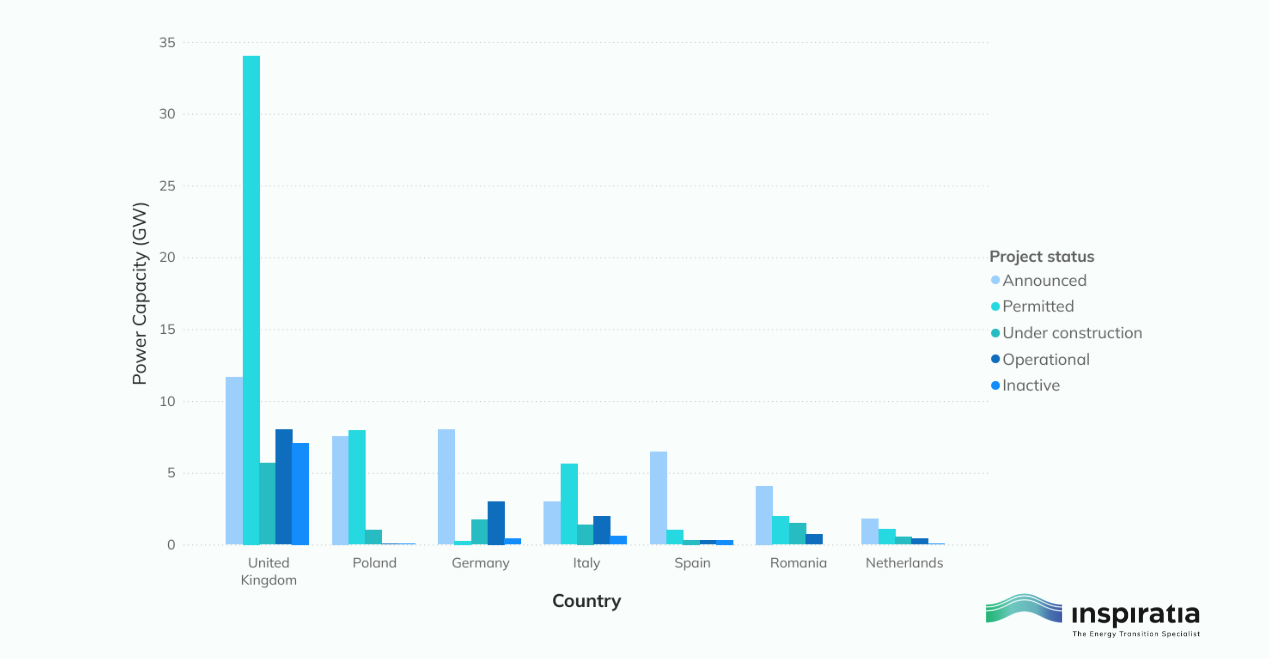
Top seven European countries by BESS capacity, as of July 2026
Source: JRC European Energy Storage Inventory, processed by inspiratia
From the latest figures, the UK dominates Europe's battery storage in power capacity, with nearly 8 GW operational and a substantial 51 GW pipeline. Poland and Romania present an intriguing emerging-market story. Both have relatively small operational BESS capacity (sub-1 GW), yet their pipelines exceed 16 GW and 7.5 GW respectively, signalling ambitious plans to support grid flexibility as coal phase-outs accelerate and variable renewables scale up.
Germany's pipeline appears relatively modest in permitted capacity given its industrial base and Energiewende commitments, whilst Italy and Spain are growing Mediterranean storage capacity.
Notably absent are the Nordic markets, where deal flow is quite strong, but BESS project capacity is small. This is due to extensive hydropower assets reducing the commercial case for large-scale battery deployment.
Renewable intermittency and price volatility driving BESS development
Europe’s battery energy storage market is being pulled by three forces: faster renewable deployment, sharper power-price volatility and rising demand for grid flexibility. As solar and wind capacity grows, periods of surplus generation and negative pricing are becoming more common. Historically, this is the fundamental role of storage in shifting power across the day, capturing arbitrage value and supporting system balancing.
To further investigate the issue, inspiratia spoke with Pietro Rabassi, Executive Vice President at Nord Pool, for details.
"While no single market is the best, there is a strong correlation between renewable energy penetration and demand for BESS. The intermittency of renewables is the main driver of price volatility, and BESS therefore has an important role to play," Rabassi explains.
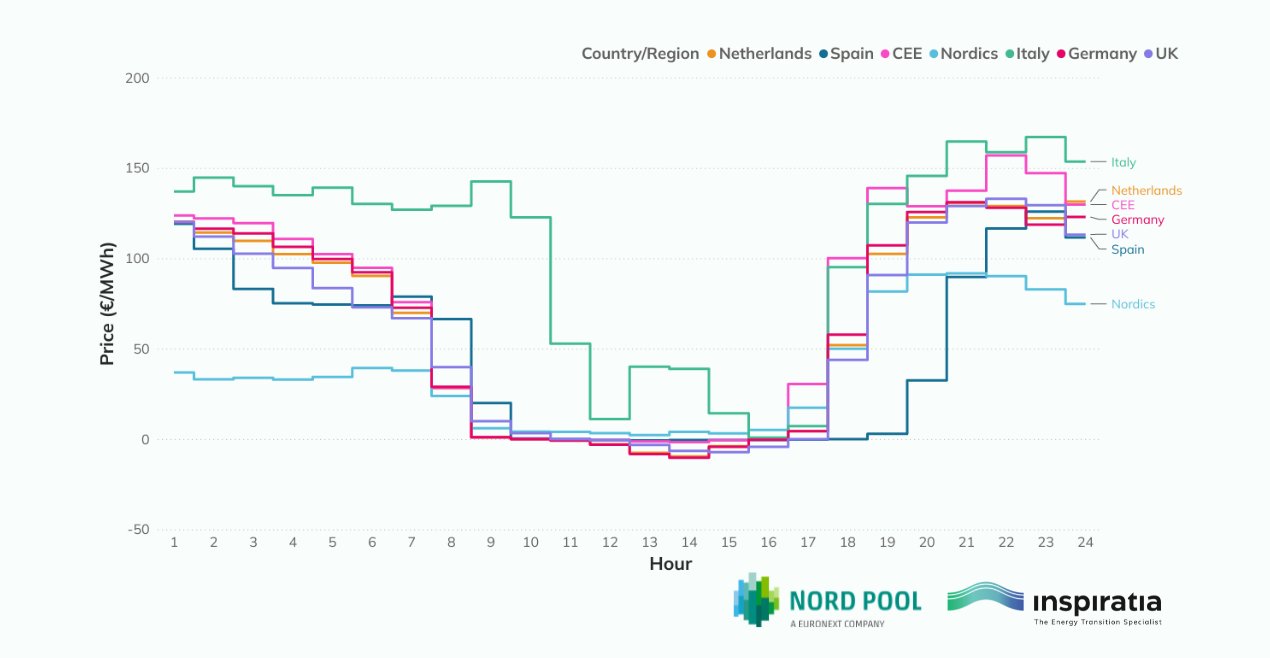
Day-ahead electricity prices by delivery hour on 4 July 2026
Source: Nord Pool (UK N2EX, Nordic SYS, CWE with Germany, Netherlands and Poland, SEE with Bulgaria and Romania); ENTSO-E (Spain and Italy), processed by inspiratia.
Note: Nordic data aggregate Denmark, Finland, Norway and Sweden, while Central and Eastern Europe (CEE) data aggregate Poland, Bulgaria and Romania. The Nordics, CEE and Italy comprise multiple bidding zones. Where applicable, quarter-hourly prices have been aggregated to hourly values. The prices shown are representative and intended for illustrative purposes.
Zero and negative pricing remain key indicators of power market volatility. On 4 July 2026, nearly all European markets covered in this analysis recorded at least one hour of zero-priced electricity, with day-ahead price spreads reaching almost €120/MWh (£102/MWh; $138/MWh). Spain exhibited the most pronounced duck curve, with prices remaining depressed for much of the day as strong solar generation weighed on wholesale markets. Spain also recorded the highest incidence of negative pricing in July 2026, with seven days of negative-price events recorded by mid-month, followed by Poland with five days.
"Recently in Spain, we have seen investors pulling out of solar assets that are not coupled with BESS," Rabassi adds.
This highlights the growing revenue challenge facing renewable energy developers. At the same time, widening intraday price spreads are strengthening the investment case for BESS, not only creating greater opportunities to capture value through arbitrage, but also reducing the investment loss in renewables during midday oversupply.
"Pricing signals should be communicated freely and openly from the market to investors. Rather than shooting the messenger, changing prices in the market could help policymakers rethink regulation and make the energy system more harmonised and efficient," Rabassi concludes.
Policy as a driver of BESS revenue diversification
While arbitrage through price volatility is the most traditional revenue model, the importance of diversification for BESS through frequency control, balancing and other ancillary services releases the potential of BESS and increases investment value.
Monthly gross revenue simulation of BESS project in Poland, 2023 – May 2026
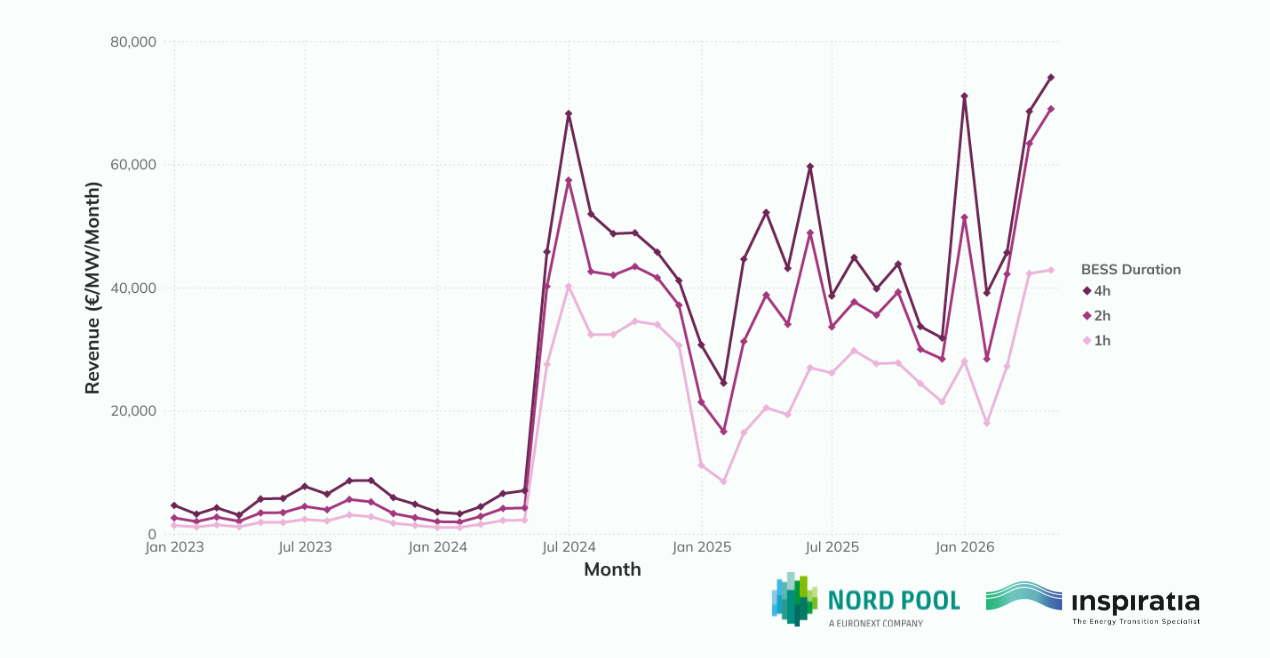
Source: Nord Pool Clean Horizon Storage Index, processed by inspiratia
Note: Index for Poland market is calculated monthly based on participation in Day-Ahead, FCR UP, FCR DOWN, aFRR Capacity Reservation, aFRR Energy Activation, mFRR Capacity Reservation, mFRR Energy Activation, Intraday; Index methodology updated in January 2026 by Clean Horizon as original data provider
Poland provides a clear example of how policy and market reform can transform BESS economics. The introduction of the balancing market reform in June 2024 created new revenue streams through ancillary services, including FCR, aFRR and mFRR, while expanding participation opportunities for battery storage assets. Combined with strong demand for flexibility, the reform increased BESS revenues from roughly €5,000 to €40,000 per MW per month. This aligns with Poland’s recent BESS pipeline growth and highlights the importance of revenue stacking in supporting storage investment.
Conclusion
Across Europe, the UK continues to lead the BESS market in both operational capacity and deployment activity, followed by Germany and Italy. Spain and Poland appear poised for the next phase of growth, supported by rising price volatility and more frequent zero and negative pricing events.
As the sector matures, revenue stacking is increasingly underpinning project economics, while supportive policy frameworks and evolving market design are unlocking new sources of value. Strong development pipelines across multiple geographies suggest the European BESS market remains on a robust growth trajectory.
Join us on 29 October 2026 at inspiratia's Energy Storage Summit Europe in Munich