Are signs of saturation emerging in the UK BESS market?
 Stanley Lam
The UK battery energy storage market remains Europe’s most advanced, with deal activity and project scale continuing to grow. Financial closes rose sharply between 2020 and 2025. Yet as pipeline volumes expand and revenue pressure intensifies, is the market showing early signs of oversupply and slower investment progression?
How the UK BESS market compares with the previous year
The UK BESS is in a stronger physical position than last year, with operational capacity rising to about 6.9GW and 2025 additions already topping 2024’s total. However, market revenues have weakened versus late 2024, so the sector is growing fast while near-term returns are less favourable.
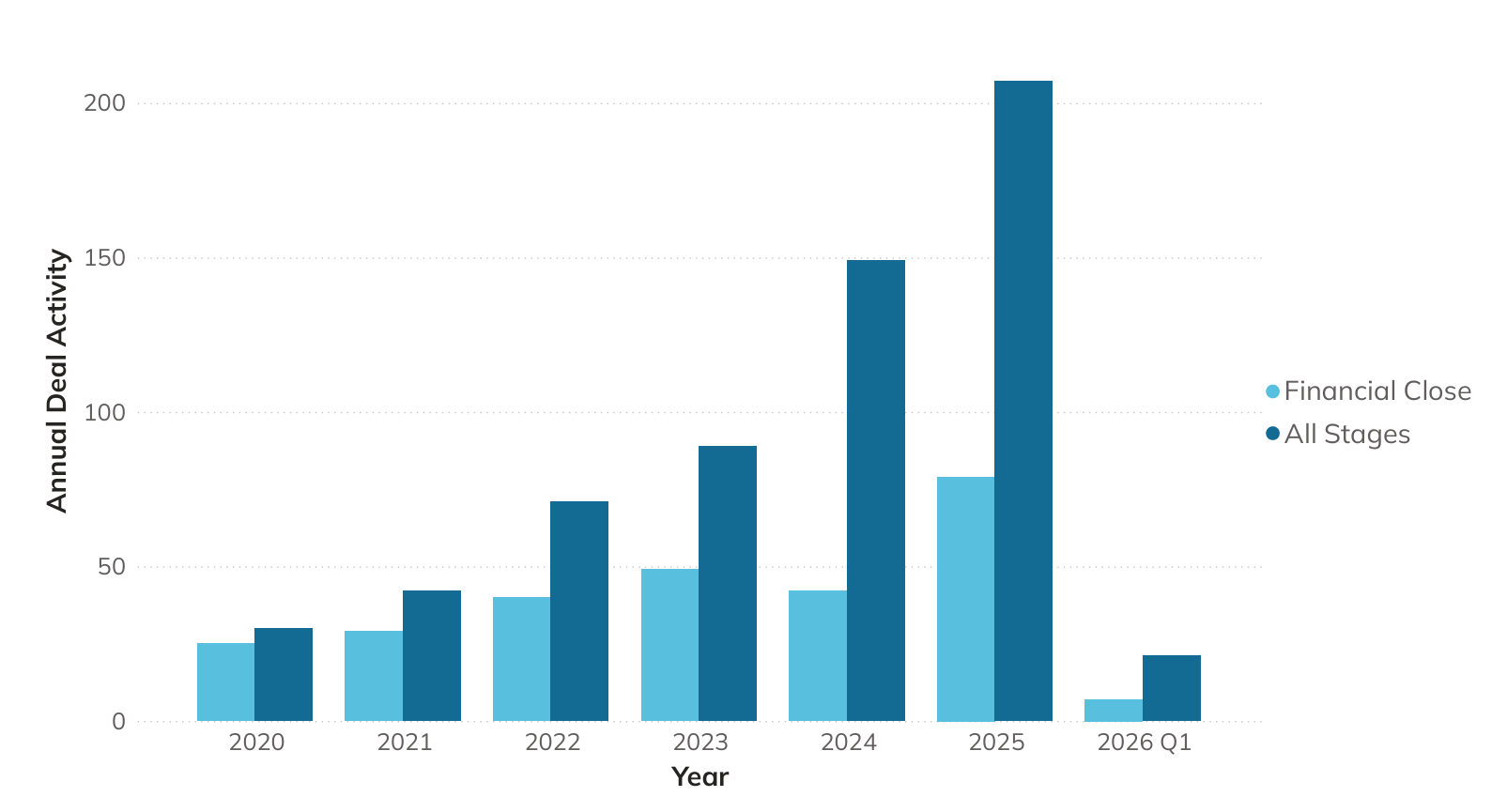
Financial close of BESS projects in the UK, 2020 to 2026 Q1
Source: inspiratia’s Deal Database
Note: All Stages include projects recorded in all project stages, such as planning, announced, approved and other pre-closed projects.
From 2020 to 2025, UK BESS financial close activity showed a clear upward trend overall, rising from 25 projects to 79 projects, an increase of 216%, despite a temporary dip in 2024. Activity increased from 25 projects in 2020 to 29 in 2021 (+16%), then to 49 in 2022 (+69%), before easing slightly to 42 in 2023 (-14%). The market then rebounded strongly to 79 projects in 2025 (+88% versus 2024), underlining continued investor appetite and the UK’s supportive market design. By Q1 2026, seven projects had already reached financial close, suggesting a relatively modest start to the year when compared to 2025.
Annual BESS deal activity in the UK also rose sharply, increasing from 30 projects in 2020 to 207 in 2025. However, although the number of projects reaching financial close continued to grow, the share of total deals achieving financial close declined. This resonates with the public market data, suggesting that while the UK BESS market is expanding rapidly, a smaller proportion of projects are progressing to financial close.
The result also aligns with inspiratia’s recent analysis of the UK’s grid connection reform, which points to signs of potential market stagnation as the battery storage pipeline faces clear oversupply. With Gate 2 capacity far exceeding system needs, scarcity value is weakening, while clustering, grid constraints and revenue compression are intensifying. Combined with tighter financing conditions, this suggests a more selective and slower-moving investment environment.
New BESS project activity continues to grow
With new projects continuing to enter the market, concerns about saturation are understandable. However, inspiratia’s data suggests there is still room for growth, with a rising share of financially closed deals representing primary financing for new BESS projects.
Financing purpose of financial-closed BESS deals in the UK, 2023 to 2025

Source: inspiratia’s Deal Database
Before 2023, the market was driven mainly by acquisitions of built BESS projects, pointing to a more cautious investment appetite rather than a willingness to finance new-build assets.
From 2023 to 2025, UK BESS financing shifted away from acquisition-led activity towards primary financing and refinancing. Among projects reaching financial close, acquisitions fell from 64.52% in 2023 to 43.96% in 2024 and 33.88% in 2025, while primary financing rose from 32.80% to 47.34% and 49.88%, becoming the largest category. Refinancing also increased steadily, from 2.69% to 8.70% and 16.24%.
This suggests the market is still growing, with more investors willing to finance new-build projects as perceived project risk declines.
Recent large-scale projects reached financial close in the UK
The UK battery storage market recorded a series of large-scale financings in 2025, underlining both growing project size and increasing market maturity.
Key primary financings included the 1.45GW Thorpe Marsh battery storage project, which reached financial close in September 2025 with a total transaction value of £1.039 billion ($1.406bn; €1.201bn), and the 680MW Carrington Storage project, which closed in November, both representing utility-scale developments. Notable refinancing activity included the Gresham House Energy Storage Fund refinancing, which reached financial close in August and covered a 1GW portfolio of operational assets across 28 UK sites. A major acquisition followed in April 2026, when InfraVia acquired majority stakes in Mercia Power Response and Balance Power Projects and merged them into Supernova Power, creating a combined 1.8GW pipeline.
These high-capacity deals highlight sustained investor appetite for operational and late-stage assets, alongside the increasing use of refinancing to optimise capital structures. Collectively, they reflect rising confidence in revenue visibility and the expanding role of battery storage in supporting grid stability and renewable integration across the UK energy system.
Conclusion
Over the past five years, the UK BESS market has made strong progress, supported by favourable policy and market mechanisms. However, early signs of saturation are beginning to emerge as the market expands rapidly. Projects with stronger bankability, particularly those strategically co-located with solar or wind, are likely to hold greater system value and gain priority, while less competitive pipeline projects may face a more difficult path to financial close.
Even so, major developers and financial investors continue to back larger and riskier BESS projects, suggesting the market remains attractive as it matures and gradually de-risks. We will continue to monitor developments through H2 2026.