Q&A - Sirocco Energy: making onshore wind accessible
 Maya Chavvakula
EU
Onshore WindQ&AFinancingGeopoliticsRiskAccess to traditional onshore wind energy is reserved for investors and organisations with substantial means primarily due to the costs associated with building and owning these assets, making them optimal only at utility scale.
The only option for regular households and small businesses that want to decarbonise their energy use was PV solar. The panels were affordable and in some cases even subsidised by local authorities.
Like with most things in life, the relative cheap cost comes with limitations. They typically operate at a lower capacity factor, topping off at 22% for the "high-end" versions and are only capable of producing electricity for a portion of the day.
Onshore wind turbines, on the other hand, tend to be more efficient, capable of converting over 50% of raw energy into electricity and even boast around the clock production, in theory at least, and under optimal conditions.
So, what if small businesses were given the opportunity to capitalise on the benefits of onshore wind while minimising the cost? Enter Sirocco Energy, the start-up that has designed a new onshore wind turbine model that can be financed and installed by small businesses. If implemented as planned, these turbines could reduce the cost of energy for end users by 75%.
inspirata sat down with Taras Vodyanyy, one of the founders of Sirocco Energy, to discuss the concept, the proposal and how a company with Ukrainian roots promises to be a game changer for commercial and industrial (C&I) decarbonisation.
What is the story behind Sirocco?
Vodyanyy: The company was founded by myself and my business partner Oleksandr Pryimak. We studied together at the Polytechnic University, where we trained as engineers specialising in radio-electronic devices. Oleksandr went on to work as an engineer in the wind energy sector, and I was already managing a marketing agency at the time.
While working with industrial wind turbines, Oleksandr encountered their pain points on a daily basis: complex maintenance, expensive solutions, bulky structures, and a lack of products designed for ordinary people and local businesses.
He wanted to change the status quo and so he started by applying to a startup competition and began the search for a partner that could help with the business foundation of the project. This is where I came on board and together, we travelled to Odesa, Ukraine to participate in ClimateLaunchpad by Greencubator.
Half an hour before we were due to present our pitch, we dropped by an ordinary café in Odesa and signed a partnership agreement on a napkin.
We didn't win the competition, but we received enough interest from investors and the audience to keep us going. Soon after, the first investment appeared - $50,000 from a local angel investor. He provided not only funding, but also critically important knowledge about product development, processes, go-to-market strategies, launches, and scaling.
Following this, we went through several iterations of prototypes and conducted extensive market research before identifying a solution capable of operating effectively for businesses in suburban areas.
Through grant support from the EBRD's Climate Innovation Vouchers programme, we engaged an independent R&D agency to conduct an external technology assessment. In 2021 we registered the company in the US and launched an equity crowdfunding campaign, which raised $1 million.
This allowed us to complete the development of an 8kW turbine, manufacture it, test it for more than a year in real-world conditions, and obtain real operational data. Currently, we are developing a commercial line of turbines with capacities of 30kW, 100kW, 500kW, and 1MW. This year, we are piloting these turbines across the European, US, and Ukrainian markets.
Your turbines don't look like the one most people are used to seeing, how did you come up with the design?
Vodyanyy: We have passed numerous technological iterations throughout our development process. The current design provides the turbine with specific characteristics and advantages tailored to our target clients - businesses located in suburban areas.
Throughout this journey, however, our core mission has remained unchanged: to enable the production of wind energy close to people, right where it is consumed. Looking at today's market - shaped by security challenges, grid congestion, and the rising costs of energy transmission & distribution - we are more convinced than ever of the value of on-site generation, especially for high-demand commercial consumers.
What were the main considerations for the shape and design of your turbine model?
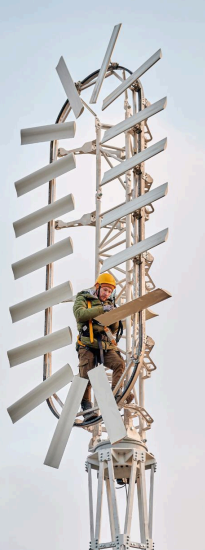
Vodyanyy: First, we needed to solve the problem of the aerodynamic noise, which is one of the most critical limitations for using turbines near residential areas. In traditional turbines, aerodynamic noise is generated by the high speed of the blade tip. Sirocco's model uses short blades that move linearly along a track rather than rotate around a central hub. This significantly reduces movement speed and, as a result, the aerodynamic noise.
Second, we needed to adapt to the real wind conditions in suburban areas. Actual wind conditions in such zones are lower, typically around 5–5.5m/s. Therefore, it was essential to ensure high efficiency at lower wind speeds.
Increasing the number of blades, precisely optimised blade angles, and carefully selected spacing allowed us to achieve the desired performance.
Third, land-use constraints. When working with businesses in suburban areas, minimising land use is critical. Our models occupy significantly less space compared to traditional turbines. A single turbine requires up to three times less land, and when installing multiple units, they can be placed much closer together than classical three-blade turbines.
What makes your prototype ideal for household / commercial use?
Vodyanyy: Our key advantage is that we make wind energy accessible where it was previously almost impossible: in suburban areas and near business facilities.
The second major advantage is the economics of the design. We use short blades with identical geometry along their entire length. These are lightweight components fixed at two points, unlike classical three-blade turbines where each blade is fixed at only one point. This approach significantly reduces material loads, simplifies manufacturing, and increases reliability.
Our design does not include a gearbox, one of the most expensive and complex components of traditional three-blade turbines. In addition, the turbine's weight is evenly distributed along the entire structure, allowing for optimized material use and reduced overall costs.
Logistics is another important factor. Our turbines can be transported in standard shipping containers, as all components are designed with a maximum length of up to 11m - something that is practically impossible for three-blade turbines. This significantly reduces transportation costs and simplifies scaling.
As a result, we deliver a much better price-to-energy-output ratio, ensuring strong project economics. Our solutions allow businesses to reduce grid electricity consumption, effectively balance generation with other energy sources, and, when combined with energy storage systems, achieve stable and predictable power supply.
Our turbines are quiet, produce minimal aerodynamic noise, have lower vibration levels, and are safer for birds.
What does the supply chain look like today, and how does it impact pilot project costs?
Vodyanyy: The 30kW turbine was deliberately chosen as the pilot format. It allows us to test an innovative technology relatively quickly and at a reasonable cost, which is essential for any new energy solution. For us, a pilot is not a demonstration on paper but a real-world market validation.
We designed the turbine to be in compliance with regulatory requirements in most markets. The structure height is 45-49m allowing all components to be transported in standard shipping containers and installed without the need for heavy lifting equipment.
Consequently, over the next three years, we expect to achieve an installed capacity cost of less than $1 million per megawatt (MW).
Regulation is another key focus. In many markets, rules were created for large wind turbines rather than decentralised generation. In Ukraine, which critically needs local and decentralised energy solutions, we will initiate close cooperation with the government to adapt the regulatory framework to this new class of technology.
To demonstrate the technology's viability on the market, we agreed to partially co-finance the first five pilot projects and provide a 5-year warranty.
What is the delivery timeline for the pilot, and for how long will you record data before commercial deployment?
Vodyanyy: Our pilot projects are already commercial in nature, but they are implemented under more favourable financial conditions and include maintenance. For the Ukrainian market, we can deploy projects within a timeframe of a few months to a year, depending on the regulatory environment.
The main factor affecting the overall timeline is obtaining permits and construction approvals.
Is household / C&I use the primary near-term target, or would you also consider grid-scale deployment?
Vodyanyy: In the near term, our primary focus is on the self-consumption model for commercial and industrial (C&I) customers. We see the greatest value in helping businesses reduce grid dependence. Furthermore, on-site generation plays a critical role in alleviating grid congestion.
We consider grid-connected and larger-scale projects to be the next stage of development, primarily through partnerships with developers and energy companies in specific markets. Our technology enables projects implementation in locations where traditional turbines are simply not feasible. Effectively, we are unlocking wind generation in suburban areas.
How are you funding the pilot, and do you plan to raise capital in 2026? Who are your target investors?
Vodyanyy: We fund our business through a combination of sources: angel investors, grant programs, and the sales of our first turbines. In parallel, we actively engage with venture capital funds and family offices interested in innovation and technology scaling.
We currently have an active funding round focused on financing pilots and transition capital for the commercial stage of scaling production, and expanding into new markets.
As a company partially headquartered in Ukraine, how has the war impacted your business?
Vodyanyy: To some extent, the war has accelerated the development of our technology, as it highlighted the importance of energy security, where decentralised generation plays a key role. It accelerated the realisation of the need for decentralised electricity for businesses in Ukraine, creating strong demand for our technology.
At the same time, the war has strained internal processes. It reduced the availability of skilled labour and introduced additional security challenges for production. All of this compels us to take a more rigorous approach to scenario planning and risk diversification by decentralising our supply chains, manufacturing, and logistics.
Finally, where do you see Sirocco in five years?
Vodyanyy: Sirocco has a detailed long-term development strategy spanning several decades. For better or worse, this is a market where project lead times are measured in years.
Over the next five years, our focus is on the full launch of a product line ranging from 30kW to 1MW turbine models and optimisation of the manufacturing process. After completing this phase, we plan to establish our own manufacturing facilities in the US and Europe.
By 2028, we aim to reach approximately 150MW of installed capacity. This will provide the necessary company valuation growth for the next funding round and create a sufficient portfolio of deployed projects to support further expansion into new markets.