inspiratia’s Investing in the Energy Transition 2026: insights (day 2)
 Daniel Atzori
inspiratia's Investing in the Energy Transition summit brought lenders, investors, developers, advisers and analysts to the Westin Palace in Milan on 1–2 October to examine how Southern Europe's energy transition is being financed and where capital is likely to go next. Key insights from the first day, which covered project financing, storage, data centres, PPAs, capital allocation across Southern Europe and biomethane, have already been published here.
On day two, the discussion moved from financing individual projects to how capital is being deployed through M&A and consolidation, and whether Italy can build at the pace that electrification and data centre demand now imply.
Daniel Atzori, Head of Intelligence at inspiratia, opened the second day with welcome remarks.
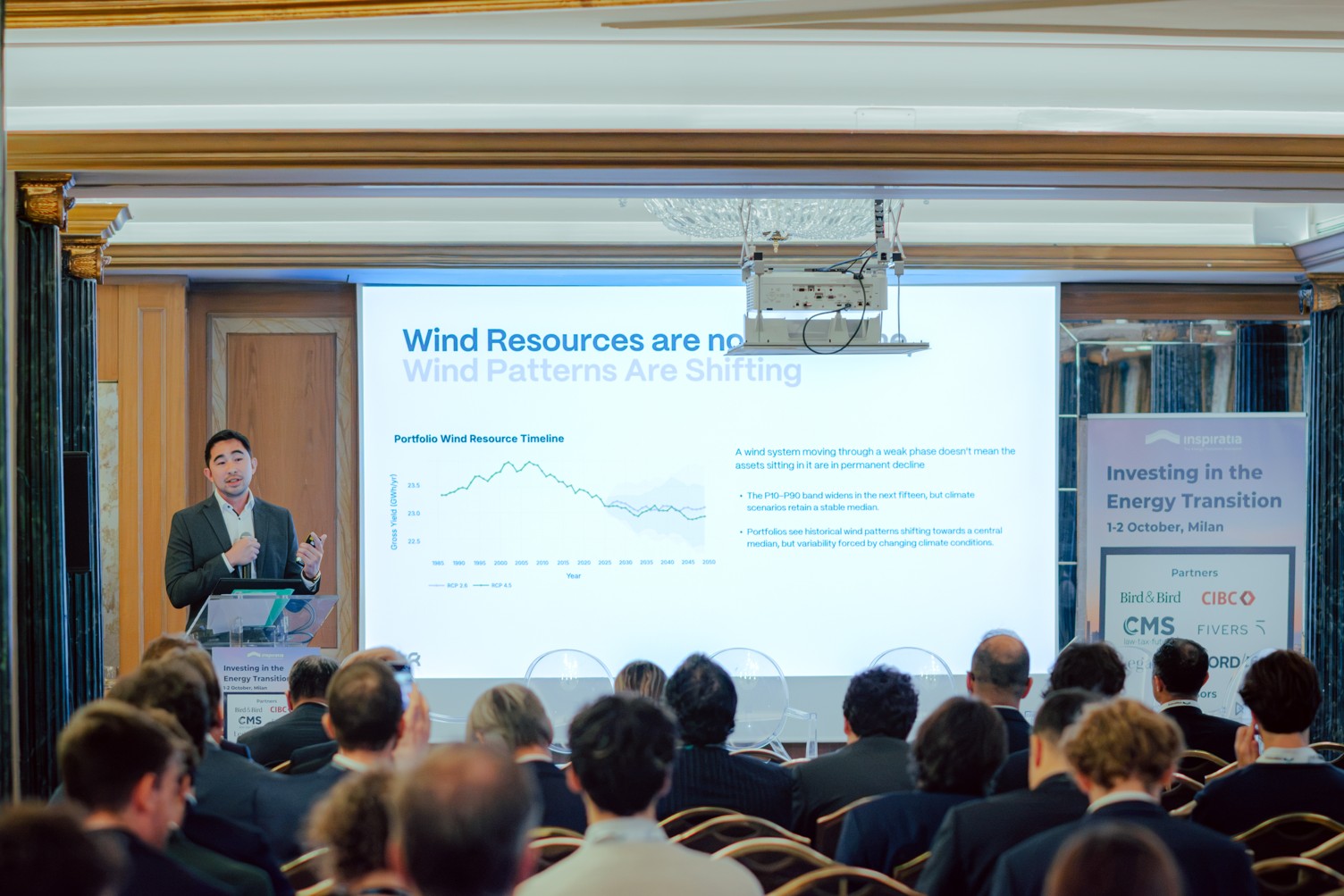
Dr Joaquin V. Ferrer, Principal Scientist at Repath, then gave a presentation on how forward-looking climate data adjusts yield, TotEx and diversification assumptions in deal valuations.
M&A and Consolidation in Italian Renewables and Storage
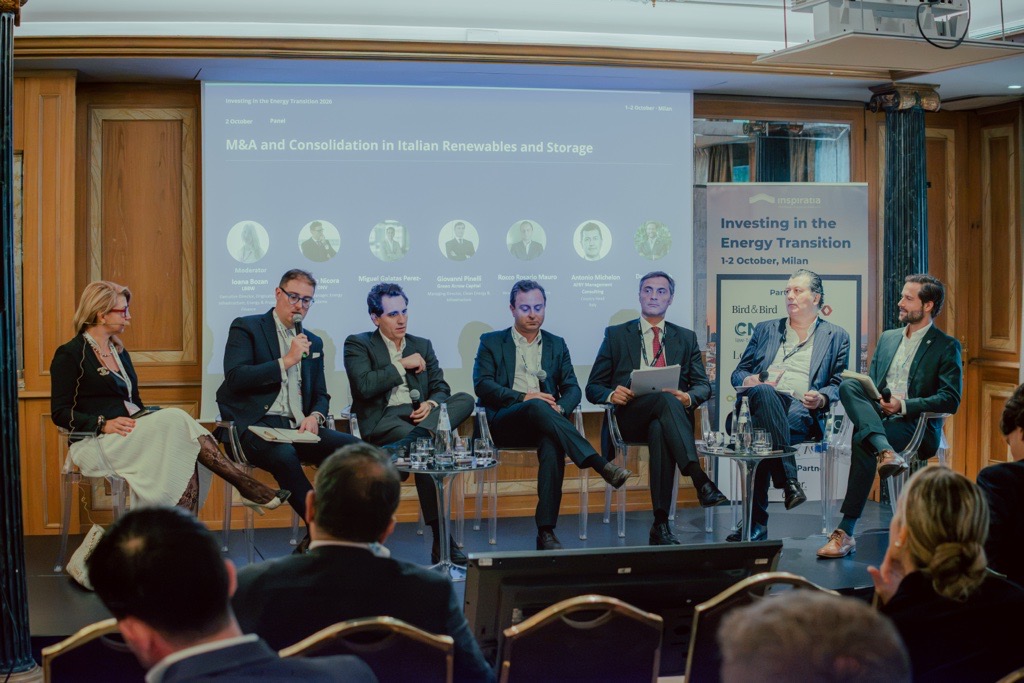
The first panel of the day, M&A and Consolidation in Italian Renewables and Storage, examined where capital is finding the most attractive entry point across development-stage assets, ready-to-build portfolios and operating platforms, and how the buyer base is evolving across domestic utilities, infrastructure funds and international investors.
Speakers included:
- Miguel Galatas Perez-Juez - nTeaser | Co-founder
- Giovanni Pinelli - Green Arrow Capital | Managing Director - Clean Energy & Infrastructure
- Rocco Rosario Mauro - ZE Energy | Head of M&A and Business Development Italy
- Antonio Michelon - AFRY Management Consulting | Country Head Italy
- Paolo Nicora - DNV | Market Manager, Energy Systems
- Daniel Csonth - Veridue AI | Founder and CEO
The panel was moderated by Ioana Bozan, Executive Director, Origination Infrastructure, Energy & Project Finance at LBBW.
Key takeaways:
- Contracted revenues under FER X and MACSE are drawing more investment into Italian renewables and storage, and investors hope the regulatory framework will remain consistent.
- BESS owners in the north, where MACSE does not apply, need to compete in ancillary services, while renewables compete in the day-ahead market, urging funds to become more sophisticated.
- Platforms are increasingly important, as investors shift from aggregating megawatts to building platforms.
- Acquisitions of asset-based platforms are increasing, with investors partnering with industrial players to develop projects and reach consistent IRRs that match their risk appetite.
- Prices awarded in the first MACSE auction, averaging around €13,000/MWh/year, have been less attractive to international investors.
- BESS platforms are integrating development, construction, O&M and distribution, managing energy as a utility would.
- In BESS, ready-to-build is a legal status and says little about investment readiness. Storage acquisitions require more accuracy and preparation than PV, and permitting adds to the difficulty.
- The origin of capital is shifting from specialist infrastructure investors towards large private equity firms. Panellists expect the market to concentrate and consolidate over the next five years, although it remains unclear who the consolidators will be.
- Capital is available but more selective, with investors focused on asset quality and platforms, and AI could be increasingly used in due diligence.
Italy's Energy Transition 2.0: What Comes Next?
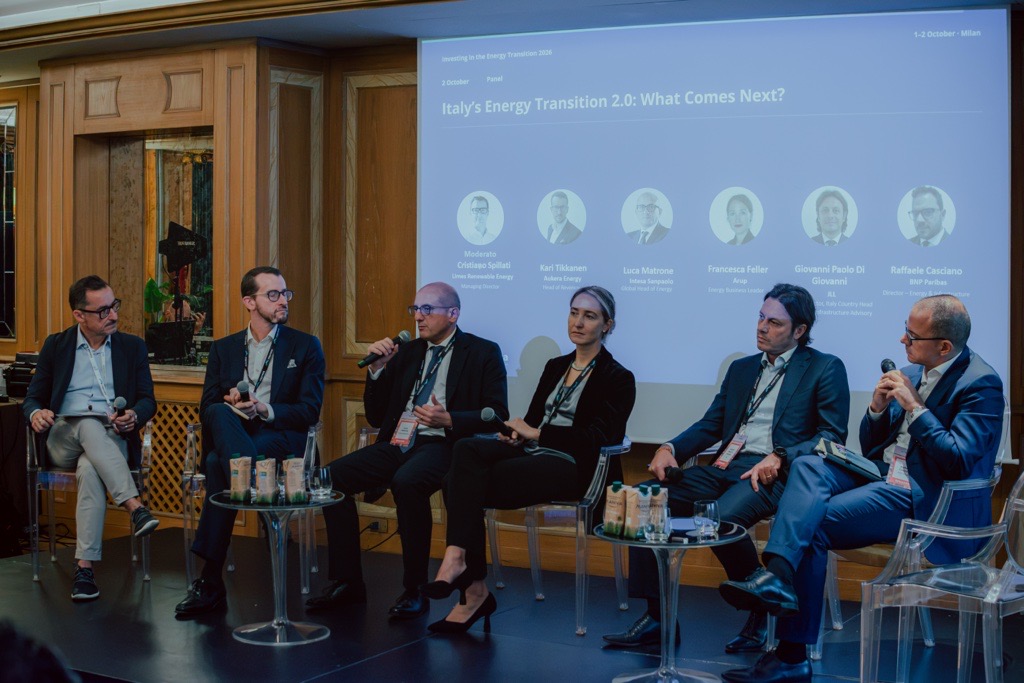
The final panel, Italy's Energy Transition 2.0: What Comes Next?, asked whether Italy can convert its pipeline into built capacity now that revenue frameworks for renewables, storage and capacity are in place and tested at auction. Panellists discussed which segments will absorb the most capital over the next three to five years, what must change in grid delivery, scheme design, and market structure, and how Italy compares with other European markets competing for the same capital.
Speakers included:
- Kari Tikkanen - Aukera Energy | Head of Revenue
- Luca Matrone - Intesa Sanpaolo | Managing Director, Head of Industry Energy, IMI CIB Division
- Francesca Feller - Arup | Energy Business Leader
- Giovanni Paolo Di Giovanni - JLL | Senior Director, Italy Country Head - Energy & Infrastructure Advisory
- Raffaele Casciano - BNP Paribas | Director - Energy & Infrastructure
The panel was moderated by Cristiano Spillati, Managing Director at Limes Renewable Energy.
Key takeaways:
- Battery storage is an emerging opportunity, but the market is still in its execution phase, and the next few years will be focused on delivery.
- Italy needs more flexibility, given limited interconnection with the islands and its reliance on gas imports.
- Regulatory stability is needed to ensure that many gigawatts get built.
- Panellists ranked Italy's frameworks, with 15-year MACSE contracts and 20-year FER X contracts, among the strongest internationally, and said no other European market offers incentives as broad.
- MACSE returns are very low, and there are fears of further compression, while the next auction will be larger, with Terna targeting 16GWh against 10GWh in the first round.
- Solar PV benefits from relatively high capture prices.
- A wave of M&A and consolidation is expected to continue over the next 18 months, covering ready-to-build assets as well as assets after construction.
- Permitting and authorisation procedures need to be simplified, and the grid is an issue in every market.
- Spain is difficult at the moment, but activity will continue, targeting mainly BESS rather than PV, supported by its newly approved capacity market.
- Germany has huge liquidity but very low returns, while the Nordics face regulatory issues.
- Italy is more attractive from a debt perspective thanks to its contracted revenues, but investors are squeezed as returns are not especially high.
The discussion will continue at inspiratia's Energy Storage Summit – Europe, held at the Eurostars Grand Central in Munich on 29–30 October, where grid integration, financing models and the bankability of standalone and co-located projects will be on the agenda.