Energy Storage Summit – Europe 2026: key takeaways from day two
 Daniel Atzori
 Stanley Lam
EU
Battery StorageEventFinancingGeopoliticsPolicy & RegulationRiskThe second day of inspiratia’s Energy Storage Summit – Europe closed the conference at the Eurostars Grand Central in Munich today, with a morning programme that moved on from the continental markets debated on day one to Great Britain’s maturing storage sector, and then to whether Europe can build its own battery supply chain at scale.
Catching up on day one
Following the fifth panel on 29 October, Stanley Lam, senior analyst, and Vikas Makwana, head of data & product at inspiratia, presented on Spain’s battery storage market and gave a special preview of upgrades coming to inspiratia’s deal database.
Spain’s Battery Storage: Mapping the Investment Opportunity
Key takeaways:
- Significant untapped potential: a 9.98GW pipeline against a target of 16GW of battery storage by 2030, but the small share of projects under construction shows the gap between ambition and deployment
- Financial close signals growing confidence: of the 25 BESS projects above 50MW recorded by inspiratia in 2026, 19 have reached financial close, with closings rising sharply since 2025
- Extremadura leads with a 2.05GW pipeline, backed by abundant solar resources and a clear need for flexibility, but faces the most severe energy losses at the grid-node level of any region
- Andalucía has a smaller 691MW pipeline but the most available grid-node capacity, which could give developers who move early an edge in securing connections
Modo Energy also ran a workshop on day one on using benchmarks to structure revenue swaps for battery storage assets.
Unlocking Revenue Swaps with BESS Benchmarks
Key takeaways:
- Benchmark-based revenue swaps reduce revenue uncertainty while preserving some merchant upside; the swap settles the difference between a fixed rate and an agreed benchmark
- The gap between actual asset revenues and the benchmark creates basis risk: the closer the benchmark tracks performance, the more effective the hedge
- Swaps allocate risks to the parties best positioned to control them, giving investors exposure to battery revenues without the complexity of managing the underlying asset
Opening of day two
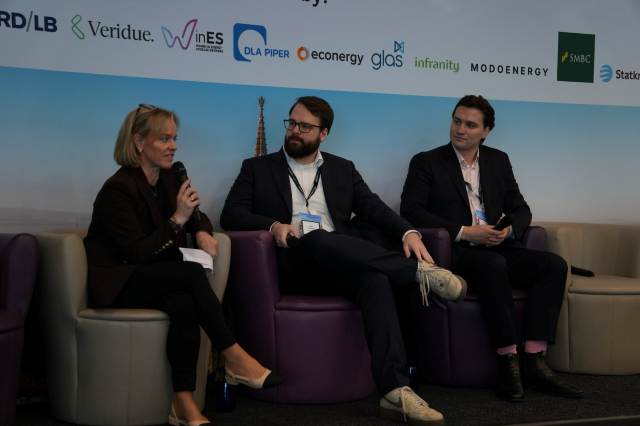
The first panel of the day focused on the storage market in Great Britain (GB), where merchant revenues now sit alongside new contracted routes, including cap and floor for long-duration storage.
Speakers included:
- Max Stirling – senior director of energy and infrastructure advisory at JLL
- Tom Smout – head of storage at LCP Delta
The panel was moderated by Natasha Luther-Jones, global chair of the energy and natural resources sector at DLA Piper.
Great Britain’s Storage Market: Depth, Duration and Cap and Floor
Key takeaways:
- GB and Germany differ markedly: GB lacks depth in tolling agreements and floors are more prevalent, while tolls are popular in Germany and easier to negotiate there
- The GB capacity market provides a base of contracted revenues; in a fully merchant market such as Germany, projects would need a higher floor
- Lenders assess structures at both asset and portfolio level, with portfolios spreading risk across a larger number of assets
- Holdco financing shows BESS is becoming an established infrastructure asset class in GB
- The GB optimiser market is consolidating around large players, leaving little room for many smaller optimisers
- The long-duration energy storage (LDES) scheme is good for the system but creates winners and losers
- LDES is a major event for GB, as the MACSE storage auction was for Italy
- Policy risk remains
- The Clean Power 2030 (CP30) process to organise how and when projects connect is an important development
- GB remains attractive, helped by its developers, some of them highly sophisticated; repowering or augmenting batteries to extend asset life is the next step
- 2026 was a buoyant year for M&A driven by consolidation among large platforms and sales of operational assets as funds reach the end of their life; new equity and repowering deals are on the horizon
- UK developers are starting to look at Europe, targeting large assets in Germany, with interest also in Italy and Spain, as Nordic utilities expand in offshore wind, helped by proximity to London’s project finance hub
Nord Pool’s Levente Lukacs then presented on market design for a resilient and green energy future.
Market Design for a Resilient and Green Energy Future
Key takeaways:
- Nord Pool’s current focus is expansion in the Balkans; overall, Central and Eastern Europe are markets to watch, with Bulgaria performing well on storage
- The company plans to launch German power futures in April 2027, subject to regulatory approval
- Volumes are being traded closer to delivery, driving strong growth in intraday trading
- The 2022 energy price crisis is over, but high electricity prices remain a structural threat to European industrial competitiveness, and volatility is still high, even as renewable electricity has become cheaper with growing capacity
- Cross-zonal trade, alongside renewables development, is one lever to mitigate high-price events
- Europe’s growing need for flexibility is expanding the pool of short-term trading assets
The second panel of the day turned to whether Europe can build its battery supply chain at scale, picking up the Net-Zero Industry Act debate from the pre-conference gathering hosted by Bird & Bird.
Speakers included:
- Laura Belardinelli – group general counsel at Galileo
- Millie Newmarch – growth manager at Infyos
- Roberto Jimenez – executive director at BW ESS
- Levente Lukacs – market manager for Central, Eastern and Southeastern Europe at Nord Pool
- Mathy Udayachandran – director of energy and natural resources at CIBC
- Mohammed Qudaih – solutions director at CATL
The panel was moderated by Stanley Lam, senior analyst at inspiratia.
The Battery Race: Can Europe Build at Scale?
Key takeaways:
- China leads battery manufacturing, accounting for 88% of batteries imported into the EU; its years of investment worth billions are hard to replicate, making joint ventures the more likely route for bringing technology into Europe
- Panellists made the case for a European supply chain: manufacturing capacity would also enable recycling and partnerships with mining companies, giving Europe more control and reducing its exposure to logistics risks
- The challenge is striking the right balance between a more resilient European supply chain and business cases that make sense, with policy needing to keep battery storage competitive
- Lenders focus on high-quality counterparties with a reliable record of components and equipment, costs and long-term compliance
- Buyers face strong regulation, with legal requirements for certain components and a strict contractual framework, and the law will continue to evolve
- Developers must ensure systems comply and know where their assets come from
- Lenders also assess suppliers’ financial resilience and ability to step in if an asset fails, alongside performance over time, degradation assumptions and exposure to trade restrictions
- Understanding supply-chain risk is essential, and supplier due diligence should start early; greater transparency and standardisation of data would make it more efficient
- Cybersecurity is now being placed at the top among all risks